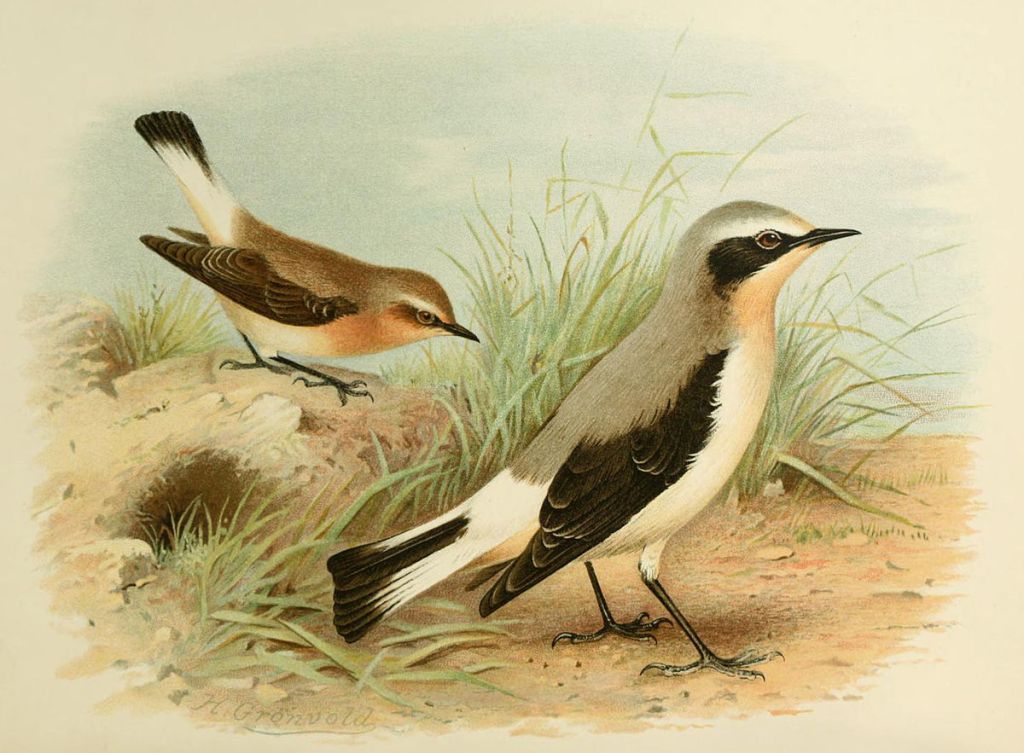
This lively bird is essentially an inhabitant of the wilds, ascending to the summits of the highest hill. It is the object of curious superstitious ideas, which may originate from its habit of frequenting old churchyards, ruins and sepulchral cairns. Its presence is considered in some localities to foretell the death of the spectator; in others the evil fortune is only considered likely to ensue if the bird be first seen on a stone; but should its appearance be first observed whilst sitting on turf or grass, good luck may be expected.
Nelson/Birds
When they fly they flash the white rump that gave them their name, a bowdlerised form of ‘white-arse’; their soft sun-bleached shades of pink and buff are topped with a black bandit’s mask. Weighing just two tablespoons of sugar, the wheatear makes one of the longest journeys of any small bird, crossing ocean, ice and desert from sub-Saharan Africa.
various
They have here an abundance of wildfowl such as pheasant, partridge, woodcock, snipe, quails, also duck and mallard. Particularly they have the bird called a wheatear or alternatively, the English Ortolan, the most delicious taste that can be imagined for a creature of one mouthful, for ‘tis little more.
Defoe/Tour
 THE NORTH RIDING PROJECT
Leave a comment